Economist Antony Davies argues that the government should stop subsidizing student loans, because it's creating a college bubble. But his argument is inexcusably uninformed.
For one, he says that Fannie Mae and Freddie Mac caused the housing bubble. At best, that statement is controversial.
Second, he says that student loan subsidies caused the large increase in college costs. Good God. It accounts for a little bit of the increase, but mostly it's due to a lot of other things.
He also argues that pure market outcomes would lead to efficient amounts of college loans. Totally false. Even a cursory glance at the relevant literature would reveal that this is not the case. The student loan market suffers from multiple market failures, leading the market to provide too few loans to students.
Fourth, the logic of bubbles doesn't even apply to this situation. The housing bubble was built on the presumption that housing prices would continue to rise indefinitely. There is no analogous assumption in student loans. You can't sell your degree after you get it, so it doesn't matter if the value of a degree rises or falls. There's no good reason to expect hordes of students to suddenly stop paying their student loans. Annie Lowrey explained this well at Slate last year.
Once again I find myself wondering: what led this person to write this? Why are people paying this man's salary? How did this guy get an economics degree?
Oh, for the days when libertarians respected Hayek. Today's libertarians seem to constantly dismiss the complexity of social problems, and suffer from the fatal conceit of uninformed central planning more than any other group I've seen.
Showing posts with label pseudo-economics. Show all posts
Showing posts with label pseudo-economics. Show all posts
Thursday, June 14, 2012

Friday, June 8, 2012
Exploding Estonian cigars at Cato
I've watched a few videos of Dan Mitchell, a senior fellow at the Cato Institute, explaining economic concepts. I found them underwhelming. But his recent blog post attacking Paul Krugman at Cato@Liberty really takes the cake, in terms of sheer confused incompetence.
Krugman started the discussion by noting that Estonia's economic recovery, touted by some as a poster child for austerity, has been so-so.

This simple statement, along with the graph, constitute the entirety of Krugman's post.
Mitchell's response is bizarre:
Krugman's post, discussing Estonia's recovery from the 2008 recession, is misleading... because it only shows Estonia's recovery from the 2008 recession? What in the world? This statement is too bizarre, there must be some kind of explanation later in the article. ... But there's not.
And it gets worse:
"Krugman presumably wants us to think that the downturn coincided with spending cuts." No, Krugman, like every sane person alive, "presumably" wants us to think that the downturn coincided with the worldwide recession of 2008. Has Dan Mitchell been living on Mars? Where is this incredible straw man coming from, the idea that Keynesians think the recession in 2008 was caused by cuts to government spending? This isn't even a technical economics mistake. Any person who has watched the news at some point during the last 4 years knows that the recession was caused by the housing bubble, etc.
I don't understand how someone like this manages to tie his shoes in the morning, much less get a degree in economics. Why does Cato employ this person? At best, he is a crank. At worst, psychotic.
Krugman started the discussion by noting that Estonia's economic recovery, touted by some as a poster child for austerity, has been so-so.

This simple statement, along with the graph, constitute the entirety of Krugman's post.
Mitchell's response is bizarre:
Krugman is very guilty of cherry-picking data. If you look at the chart that accompanies his post, Estonia’s economic performance isn’t very impressive, but that’s because he’s only showing us the data from 2007-present.
The numbers are accurate, but they’re designed to mislead rather than inform
Krugman's post, discussing Estonia's recovery from the 2008 recession, is misleading... because it only shows Estonia's recovery from the 2008 recession? What in the world? This statement is too bizarre, there must be some kind of explanation later in the article. ... But there's not.
And it gets worse:
But before exposing that bit of trickery, there’s another mistake worth noting. Krugman presumably wants us to think that the downturn coincided with spending cuts. But his own chart shows that the economy hit the skids in 2008 – a year in which government spending in Estonia soared by nearly 18 percent according to EU fiscal data!
"Krugman presumably wants us to think that the downturn coincided with spending cuts." No, Krugman, like every sane person alive, "presumably" wants us to think that the downturn coincided with the worldwide recession of 2008. Has Dan Mitchell been living on Mars? Where is this incredible straw man coming from, the idea that Keynesians think the recession in 2008 was caused by cuts to government spending? This isn't even a technical economics mistake. Any person who has watched the news at some point during the last 4 years knows that the recession was caused by the housing bubble, etc.
I don't understand how someone like this manages to tie his shoes in the morning, much less get a degree in economics. Why does Cato employ this person? At best, he is a crank. At worst, psychotic.
Psychosis (from the Ancient Greek ψυχή "psyche", for mind/soul, and -ωσις "-osis", for abnormal condition or derangement) means abnormal condition of the mind, and is a generic psychiatric term for a mental state often described as involving a "loss of contact with reality". (Wikipedia)
Wednesday, May 4, 2011
Why I wouldn't bet on a currency crisis
Denis Goddard on Capitol Access argues that the dollar is collapsing, and we're headed toward hyperinflation:
This comes after a variety of predictions of hyperinflation over the last few years, none of which have panned out. I don't think this one will, either.
First, the data. Here is the Consumer Price Index, which measures inflation:

The trend over the last year or so should be taken with a grain of salt, because the CPI includes the prices of goods, such as gas and food, which vary greatly in response to changes in, for example, the weather or international politics. The core CPI, which excludes the more variable prices and is therefore a better measure of long-term inflationary trends, shows lower inflation than this graph. I'm showing the more inclusive, volatile CPI only because I don't want to be accused of underestimating inflation. (The Boston Fed has recently released research confirming that commodity prices do not predict long-term inflation.)
Here is the value of the dollar relative to other currencies:
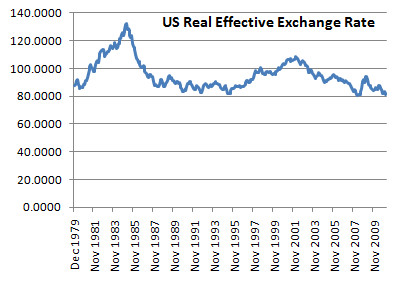
Here is the interest payed on 10-year treasury bonds:

This suggests that the bond market expects inflation over the next 10 years to be a whopping 3.46%, or even less. [Edit: Unless real interest rates are negative, which is possible. However, we can use the interest payed on inflation-indexed bonds to estimate the real interest rate, and the latest figure is .86%. The difference between the two rates, the "spread", should approximately equal expected inflation. This suggests an expectation of 2.6% inflation over the next 10 years— shockingly low.]
None of these measures looks especially frightening. And the situation is unlikely to deteriorate, for multiple reasons.
First, the Fed is well prepared to fight inflation. If inflation starts rising significantly, it can sell some of its $2.7 trillion worth of assets for dollars, reducing the money supply. And thanks to the way fractional reserve banking works, when the Fed removes currency this way, the effect is multiplied, so that removing $2.7 trillion dollars shrinks the money supply by much more than $2.7 trillion. Taking money out of the economy also increases interest rates, which is what commentators usually refer to.
The Federal Reserve famously used this strategy in 1980 and '81 to eradicate the high inflation of the 1970s. In fact, it was so successful that the disinflationary pressures caused a recession. (Though preventing inflation is much easier than reducing it, so we needn't worry about another Fed-induced recession.)
The Fed can also raise reserve requirements for banks. This would lower the money multiplier, which would lower the money supply. And, as of 2008, the Fed can pay banks interest on their excess reserves— basically, pay them to not lend out money— which allows the Fed to more easily fine-tune inflation rates and the money supply.
Besides the Federal Reserve, another force will likely intervene to prevent a collapse of the U.S. dollar. If the dollar drastically depreciates (that is, loses value with respect to other currencies), the European Central Bank will probably expand the supply of Euros in an attempt to stabilize exchange rates. Why? Because, if the dollar depreciates, American goods become cheaper, and European goods become relatively more expensive, leading to higher American exports and lower European exports. This would harm the European economy. (In fact, the European Central Bank is already responding this way.) Other U.S. trading partners face the same incentives.
So probably no currency collapse any time soon.
(Hat tip to Dean Baker and Paul Krugman, and Paul Krugman again, for some data and arguments.)
This comes after a variety of predictions of hyperinflation over the last few years, none of which have panned out. I don't think this one will, either.
First, the data. Here is the Consumer Price Index, which measures inflation:
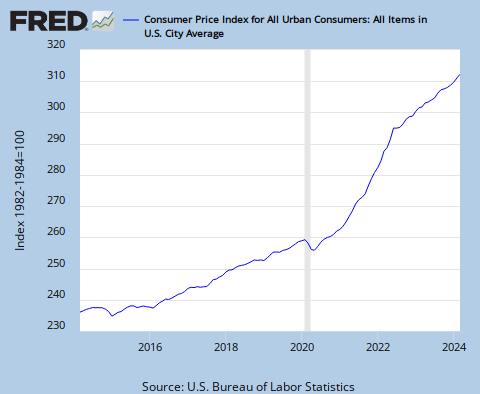
The trend over the last year or so should be taken with a grain of salt, because the CPI includes the prices of goods, such as gas and food, which vary greatly in response to changes in, for example, the weather or international politics. The core CPI, which excludes the more variable prices and is therefore a better measure of long-term inflationary trends, shows lower inflation than this graph. I'm showing the more inclusive, volatile CPI only because I don't want to be accused of underestimating inflation. (The Boston Fed has recently released research confirming that commodity prices do not predict long-term inflation.)
Here is the value of the dollar relative to other currencies:
Here is the interest payed on 10-year treasury bonds:

This suggests that the bond market expects inflation over the next 10 years to be a whopping 3.46%, or even less. [Edit: Unless real interest rates are negative, which is possible. However, we can use the interest payed on inflation-indexed bonds to estimate the real interest rate, and the latest figure is .86%. The difference between the two rates, the "spread", should approximately equal expected inflation. This suggests an expectation of 2.6% inflation over the next 10 years— shockingly low.]
None of these measures looks especially frightening. And the situation is unlikely to deteriorate, for multiple reasons.
First, the Fed is well prepared to fight inflation. If inflation starts rising significantly, it can sell some of its $2.7 trillion worth of assets for dollars, reducing the money supply. And thanks to the way fractional reserve banking works, when the Fed removes currency this way, the effect is multiplied, so that removing $2.7 trillion dollars shrinks the money supply by much more than $2.7 trillion. Taking money out of the economy also increases interest rates, which is what commentators usually refer to.
The Federal Reserve famously used this strategy in 1980 and '81 to eradicate the high inflation of the 1970s. In fact, it was so successful that the disinflationary pressures caused a recession. (Though preventing inflation is much easier than reducing it, so we needn't worry about another Fed-induced recession.)
The Fed can also raise reserve requirements for banks. This would lower the money multiplier, which would lower the money supply. And, as of 2008, the Fed can pay banks interest on their excess reserves— basically, pay them to not lend out money— which allows the Fed to more easily fine-tune inflation rates and the money supply.
Besides the Federal Reserve, another force will likely intervene to prevent a collapse of the U.S. dollar. If the dollar drastically depreciates (that is, loses value with respect to other currencies), the European Central Bank will probably expand the supply of Euros in an attempt to stabilize exchange rates. Why? Because, if the dollar depreciates, American goods become cheaper, and European goods become relatively more expensive, leading to higher American exports and lower European exports. This would harm the European economy. (In fact, the European Central Bank is already responding this way.) Other U.S. trading partners face the same incentives.
So probably no currency collapse any time soon.
(Hat tip to Dean Baker and Paul Krugman, and Paul Krugman again, for some data and arguments.)
Subscribe to:
Posts (Atom)